As is the case each month, the FDIC and OCC have released lists of performance evaluations from financial institutions receiving ratings during September of 2018.  Banks and savings associations subject to CRA examinations - and especially their CRA Officers who are responsible for CRA compliance - can greatly benefit from reviewing CRA performance evaluations that their regulators publish on similarly sized banks.  Specifically, reviewing Outstanding performance evaluations can often show a bank what unique steps can be taken to get extra CRA credit during an examination while Substantial NonCompliance ratings can explain what an insufficient CRA program looks like.

On October 23, 2018, the CFPB released the Filing Instruction Guide (FIG) for data collected in 2019.  This guide comes less than two months after the most recent version of the guide (August 2018), but is designed to be used for data collected during 2019.  The FIG is considered to be a “technical resource to help financial institutions file HMDA data collected in 2019 and reported in 2020.”

The CRCM certification (Certified Regulatory Compliance Manager) is arguably the most well respected and highest certification a compliance profession can achieve.  And for good reason. In order for you to just qualify to take the CRCM, you must be a banking professional with at least six years as a compliance professional within the last ten years (three of which need to be within the last five years).  Alternatively, you can qualify with only three years of experience if you also have met two of several different requirement options. Furthermore, you must be a compliance professionals with “management” experience overseeing the “full range of compliance risk functions.”  

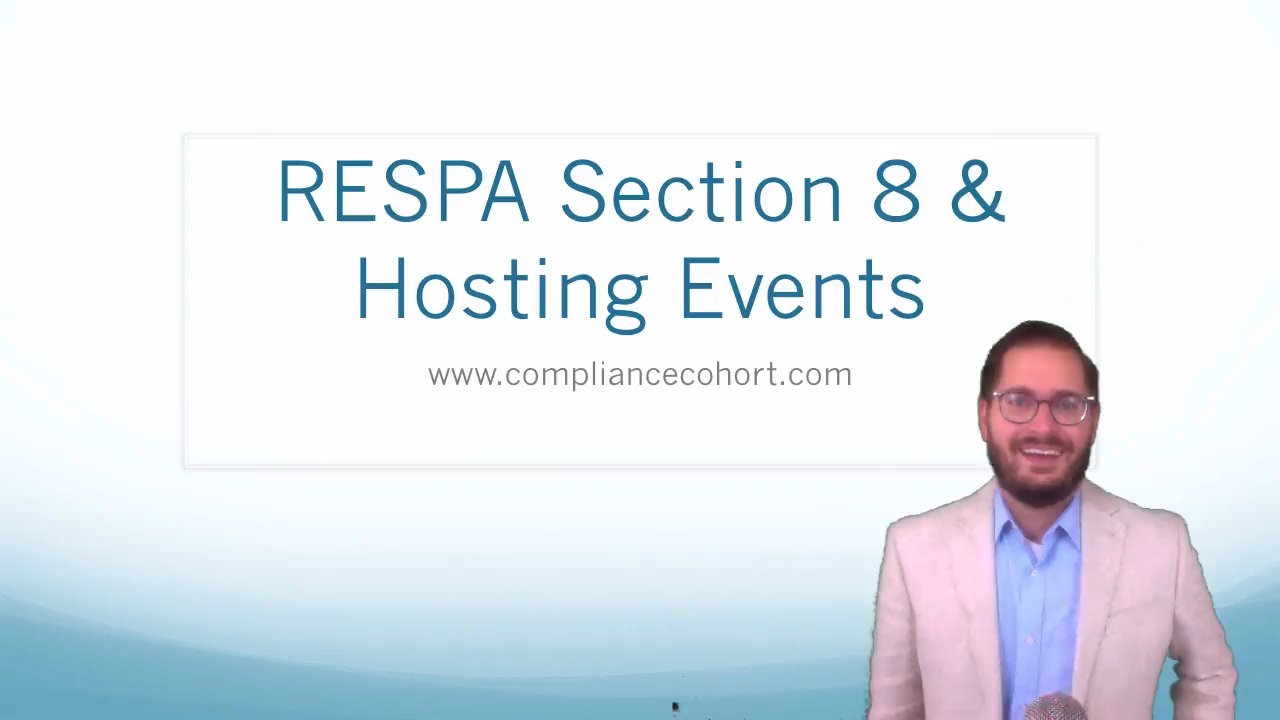
RESPA Section 8 & Hosting Lending Events

In this Compliance Clip (video), Adam discusses the compliance challenges when a lender wants to host a lending event and invite Realtors, title companies, or other settlement service providers. Networking, of course, is essential to the lending function of any creditor, but RESPA Section 8 provides some strict prohibitions that every lender should be aware of as significant fines can be assessed when the rules are ignored or not followed.

On October 16, 2018, the OCC, Federal Reserve, and FDIC published new FAQs regarding appraisals and evaluations for real estate transactions.  These FAQs clarify existing regulatory requirements and guidance that is found in two previous issuances:the 2010 Interagency Appraisal and Evaluation Guidelines and the 2016 Interagency Advisory on Use of Evaluations in Real Estate-Related Financial Transactions.

On October 15, 2018, the OCC issued a Bulletin (2018-38) announcing the updating of three booklets: “Agricultural Lending,” “Oil and Gas Exploration and Production Lending,” and “Trade Finance and Services.”  These booklets are part of the Comptroller’s Handbook and are used by examiners for their supervision and examinations of these areas.

True or False: Lender credits should never decrease.

Well, the TRID best practice over the years has said that once a lender credit is listed on the LE, it should never decrease.  This philosophy seems to align with that of the CFPB who views a decrease of a lender credit to be the equivalent of an increase of a fee.  In fact, the preamble to the final TRID rule states that “lenders are not permitted to reduce the lender credits they provided to the borrower under current Regulation X.”

So, this means that a lender credit should never be reduced, right?  Well, not exactly.

Flood Insurance for a Building with No Value

Is flood insurance required for an old dilapidated building that has no value to either the owner or lender? Adam uses this Compliance Clip (video) to answer this question and provide the regulatory guidance used to support his answer. As flood insurance penalties are easily assessed for even just a few violations, financial institutions need to ensure they don't get washed out with rogue lenders not following the rules. Oh yeah, there might even be a flood pun or two in this video.

On October 3, 2018, the main federal regulators, along with FinCEN, released a statement regarding instances in which banks and credit unions may decide to enter into collaborative arrangements to share resources to manage their Bank Secrecy Act (BSA) and anti-money laundering (AML) obligations more efficiently and effectively.  While this guidance may not be beneficial for a majority of financial institutions, this may be beneficial for very small institutions with a low-risk profile and less-complex structures, or those institutions who are owned by the same organization.